
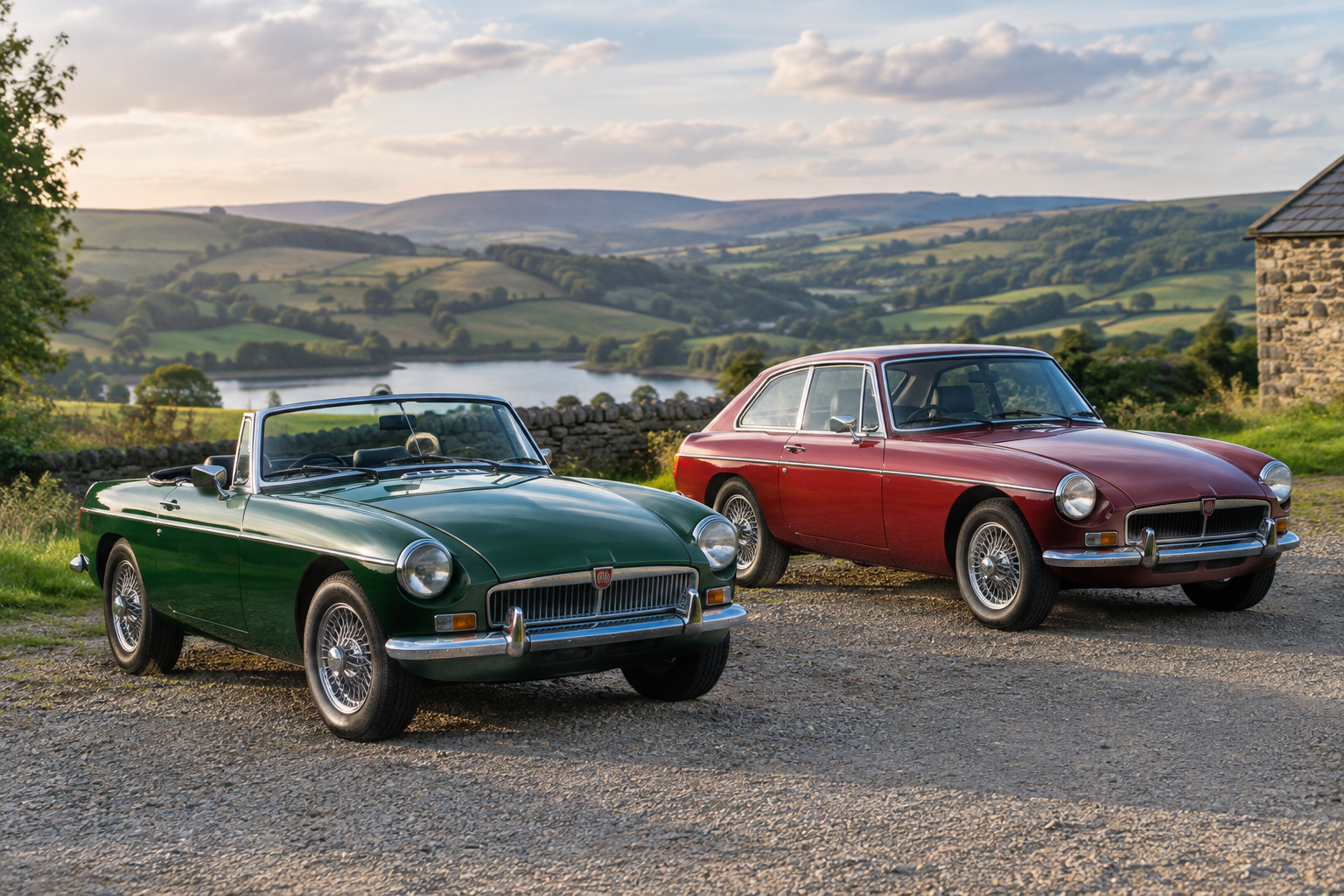
The MGB Roadster and MGB GT are closely related classic cars, yet they offer noticeably different ownership experiences. Both provide accessible classic-car motoring, familiar mechanical layouts and an engaging connection with the road. The important question is not which body style is universally better, but which one suits the way you intend to use your car.
A Roadster may appeal to drivers who value open-air motoring and a traditional sports-car appearance. A GT can be the more practical choice for regular use, longer journeys or carrying luggage. Condition, maintenance history and specification remain more important than body style alone, but understanding the differences can help you focus your search.
The basic difference between the Roadster and GT
The MGB Roadster is the open two-seat version, fitted with a folding hood. It delivers the classic experience many people associate with an MGB: a low driving position, clear view of the surroundings and the option of driving with the roof folded. Weather protection is available when required, but opening and closing the hood is part of the ownership routine.
The MGB GT uses a fixed roof and a rear hatchback design. Its roofline was developed to give the car a more enclosed and useful cabin while retaining the familiar MGB platform and driving position. The rear seats are compact, but the folding rear seat back can add useful flexibility for luggage and everyday items.
These descriptions sound straightforward, but they affect everything from the way the car is used to how it is maintained. A car used mainly for sunny weekend drives may suit a different owner than one expected to cope with mixed weather and touring luggage.
Driving character
Both models share the fundamental MGB experience: a compact classic sports car with direct controls, a manual gearbox and a sense of mechanical involvement that modern cars often filter out. The exact feel depends on the individual car, its specification and the condition of its components.
The Roadster has an especially open and immediate character. With the hood lowered, the sounds and smells of the journey become part of the experience, and the car can feel particularly well suited to slower scenic roads. The absence of a fixed roof also contributes to the traditional sports-car appearance.
The GT feels more enclosed and substantial. Its fixed roof can make the cabin feel calmer, particularly when travelling at higher speeds or in changeable weather. Some drivers prefer this more sheltered character, while others consider the Roadster’s open cabin essential to the appeal of an MGB.
Neither should be selected solely on a short drive around the block. Try to experience the car on different types of road if possible. Pay attention to the seating position, pedal layout, steering effort, gear selection, braking response and any noises from the engine, gearbox or suspension. A well-maintained example should feel coherent and predictable, regardless of whether it is a Roadster or GT.
Weather protection and everyday use
The Roadster can be used throughout the year, but it asks more of its owner in poor weather. The hood needs to be in good condition, its frame should operate correctly and the seals should keep water away from the cabin. A Roadster that is regularly driven with the hood raised should be checked carefully for damp carpets, condensation and signs that water has entered around the hood, windows or doors.
Putting the hood down is not complicated, but it should be folded correctly to avoid creasing or stressing the material. When raising it, check that the fabric is positioned properly and that the frame is not forcing the hood against the bodywork. Rushing this process can cause avoidable damage over time.
The GT has the advantage of a permanent roof and a more enclosed cabin, which can make it easier to use when the weather is uncertain. This does not mean that it is automatically weatherproof. Door seals, window seals, the hatch seal and drainage areas still require attention. Water ingress can lead to damp interiors and deterioration if it is ignored.
For an owner who wants to use an MGB for commuting, touring or regular transport, the GT may be the less weather-dependent option. For someone who sees the car primarily as a fair-weather recreation vehicle, the Roadster’s open cabin may be worth the additional hood-related checks.
Space, luggage and passengers
The GT is the more adaptable car for carrying luggage. The rear hatch gives access to the load area, and the rear seat back can be folded when extra space is needed. This makes the car useful for weekends away, shopping or carrying items that would be awkward in a Roadster.
It is important to keep expectations realistic. The GT is compact, and the rear seats are best considered occasional seating rather than a replacement for a modern family car. The available space also depends on the condition and arrangement of the interior. Inspect the carpets, trim panels, seat frames and hatch area rather than assuming that every GT offers the same usable capacity.
The Roadster has a smaller luggage area, particularly when the hood is folded. Soft bags are often easier to accommodate than rigid cases, and careful packing becomes more important on longer trips. The space behind the seats and any fitted luggage rack can be useful, but should not be treated as a substitute for the GT’s hatchback layout.
If you regularly travel with a passenger and luggage, try loading the car before making a decision. This simple exercise can reveal whether the practical limitations will be an occasional inconvenience or a continuing source of frustration.
Cabin comfort and refinement
The GT’s fixed roof provides a different acoustic environment from the Roadster. It may feel more sheltered from wind and weather, although classic-car refinement varies greatly between individual examples. A worn door seal, loose trim panel or tired exhaust system can affect the experience more than the body style itself.
In a Roadster, the driving environment changes significantly depending on whether the hood is raised or lowered. With the hood down, wind noise is naturally part of the journey. With it raised, the condition and fit of the hood have a strong effect on comfort and visibility.
Check the seats and driving position carefully in either model. Original-style seats can be comfortable when correctly supported, but upholstery, foam and seat runners may have been replaced or modified over the years. A sound driving position is important because classic-car enjoyment is reduced if every journey becomes tiring.
Maintenance considerations
Roadster and GT share many mechanical components, so their core servicing requirements are broadly similar. Regular attention should include engine oil and cooling-system checks, gearbox and axle oil where appropriate, brake inspection, tyre condition, lubrication points and examination of belts, hoses and rubber components.
The body style introduces its own areas to monitor. On a Roadster, inspect the hood material, frame, fasteners, seals and the areas around the hood attachment points. On a GT, pay close attention to the hatch, hinges, gas struts if fitted, seals and interior trim around the rear opening.
In both cars, avoid assuming that a clean exterior tells the whole story. Look at the condition of the underside, inner body areas, engine bay, boot or luggage compartment and interior. Mechanical noises, poor panel fit, damp carpets and evidence of rushed repairs deserve investigation before purchase.
Specialist support can be useful when a car needs more than routine maintenance. If you are considering a rebuilt or substantially upgraded car, you can review the MGB rebuild specification to understand the type of detail that may be relevant when discussing a car’s condition and specification. It is still important to assess the individual vehicle and request suitable supporting information.
Original specification, upgrades and modifications
Many MGBs have been improved during their lives. Changes may include braking, suspension, cooling, ignition, electrical equipment, seating, trim or engine-related components. Some upgrades can make an MGB easier to use, but their value depends on the quality of the parts, installation and maintenance.
Do not treat every modification as an advantage. Ask what was changed, why it was changed and whether the work was documented. A sympathetic improvement that solves a known usability problem may be worthwhile, while an unfinished or poorly integrated modification can create future work.
The same principle applies to Roadster and GT conversions. An altered car may suit a particular owner, but originality, practicality and future maintenance should all be considered. Examine the quality of the workmanship rather than relying on a description alone.
Choosing according to how you will use the car
Before viewing cars, write down how you expect to use your MGB. Consider the likely journey length, storage requirements, passenger arrangements, tolerance for weather exposure and whether you want a car for occasional enjoyment or more regular driving.
- Choose a Roadster if: open-air driving is central to the appeal, you are comfortable with hood care and your luggage needs are modest.
- Choose a GT if: you value a fixed roof, greater luggage flexibility and a more enclosed cabin for touring or mixed-weather use.
- Consider either model if: you are prepared to prioritise condition, history and sound workmanship over colour, trim or body style alone.
A good Roadster is preferable to a tired GT, and a well-maintained GT is preferable to a neglected Roadster. The right car is the one that fits your intended use and has been cared for in a way you can understand and continue.
Viewing cars and making a decision
When comparing examples, assess them consistently. Look for clear information about servicing, repairs, previous restoration work and current faults. Check that the car starts, runs, stops and changes gear as expected when viewed safely and appropriately. A cold start can reveal information that may not be obvious once the engine is warm.
Inspect the hood or hatch area, interior, luggage space and underside as carefully as the engine bay. Test the features relevant to your use, including the hood operation on a Roadster or the hatch and rear seat on a GT. Take time to sit in the car and imagine using it on the journeys you have in mind.
You can browse current MGB stock when beginning your search, while sold cars may provide useful context when considering the range of cars that can come through a specialist business. If you need to discuss a particular car or your requirements, the contact page provides a route to make an enquiry.
Final thoughts
The Roadster and GT offer two interpretations of the same appealing classic-car formula. The Roadster makes open-air motoring its defining feature, while the GT adds shelter and hatchback practicality. Neither choice removes the need for careful inspection, realistic budgeting for maintenance and an honest assessment of how the car will be used.
Choose the body style that makes sense for your driving, then focus on the individual example. A sound, properly maintained MGB with a clear specification will generally provide a more satisfying ownership experience than a superficially attractive car that needs constant remedial work.