
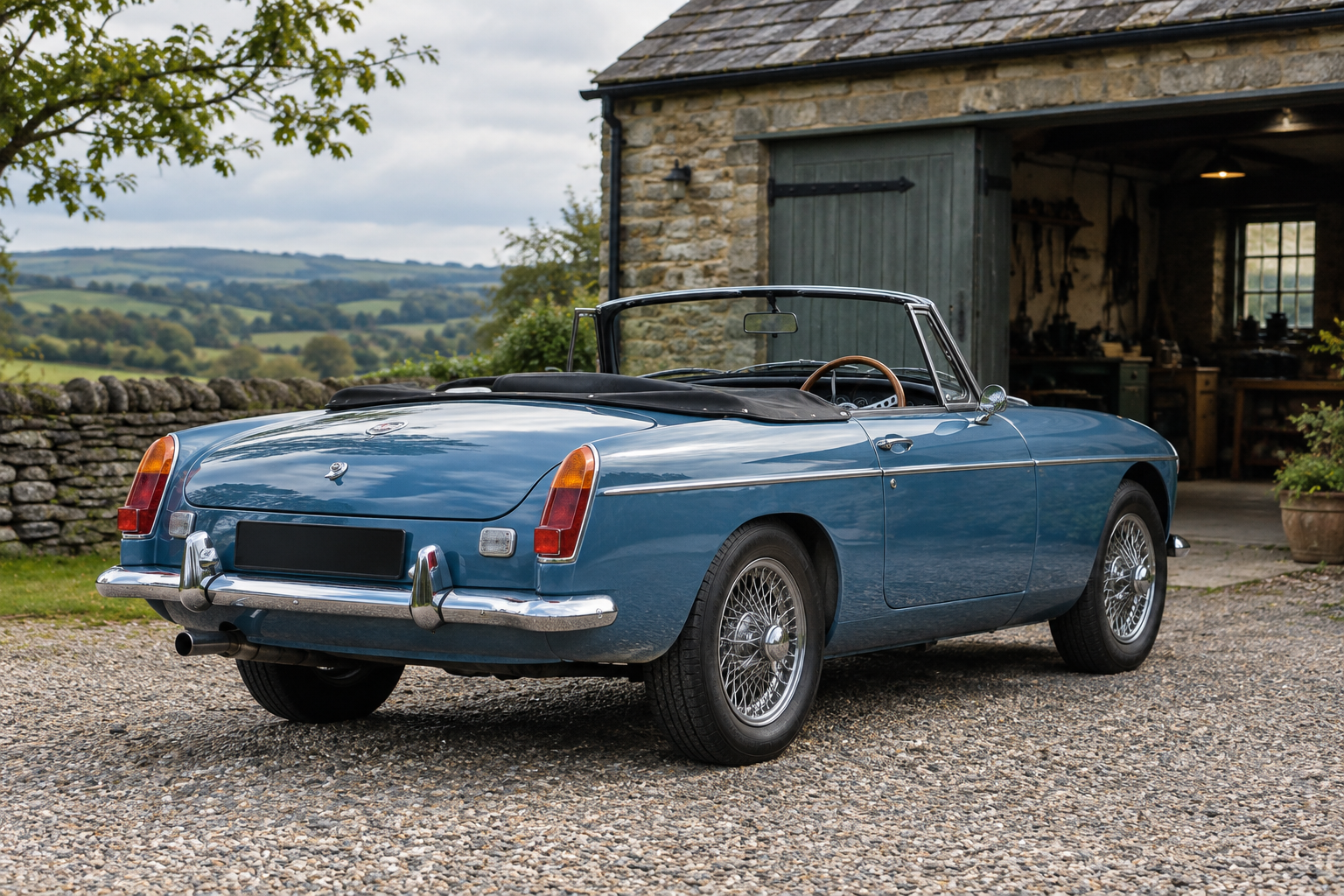
When an MGB is advertised as original, restored or rebuilt, those words can sound like clear descriptions. In practice, they often cover a wide range of cars and standards. Two MGBs may both be described as restored, yet one might have received a sympathetic mechanical recommissioning while the other has been dismantled, repaired and refinished over many years.
That does not automatically make one car right and the other wrong. The important point is to understand what you are actually buying. An MGB is not defined only by its paintwork, engine specification or appearance. Its structure, history, mechanical condition and intended use all matter.
Whether you want a largely original example, a carefully restored Roadster or a comprehensively rebuilt GT, the best choice depends on your priorities. Are you looking for authenticity, usability, individuality, long-term ownership or the opportunity to improve a car gradually? A clear definition of the work is more useful than a label on its own.
What does “original” mean on an MGB?
An original MGB is generally understood to be a car that retains much of its factory specification and has not been substantially altered. That may include its original type of engine, gearbox, suspension layout, wheels, trim and body details. It does not necessarily mean that every component is the one fitted when the car left the factory.
After decades of use, routine maintenance and repair, even a well-preserved MGB is likely to contain replacement parts. Brakes, exhaust systems, hoses, batteries, tyres, seals and service items are all expected to have been renewed at some point. An original car can therefore mean “largely faithful to its original specification” rather than “untouched since new”.
Originality can be attractive because it preserves the character of the model and gives the car a strong connection with its period. It may also be the right choice for an owner who values factory appearance and wants to avoid extensive modification. However, originality does not guarantee good condition. A car may look authentic while still needing attention to its structure, wiring, suspension, brakes or engine.
The question is not simply whether a car is original. It is whether its existing condition is understood, documented and suitable for the way you intend to use it.
What does “restored” mean?
Restoration usually means that an existing car has been repaired or renewed to improve its condition and appearance. The scope can be modest or extensive. It may involve localised body repairs, a repaint, an engine rebuild, new trim or a mixture of mechanical and cosmetic work.
There is nothing wrong with a partial restoration if it has been carried out honestly and appropriately. Many MGBs are improved in stages. An owner may first make the car structurally sound, then address the running gear, and later refresh the interior or paintwork. This can produce a very enjoyable classic, provided the work has been planned and completed properly.
The difficulty comes when the word “restored” is used without explaining what was actually done. A shiny exterior might hide older repairs, corrosion in less visible areas or mechanical components that were left untouched. Equally, a car with older-looking paint may have had important structural and mechanical work carried out to a high standard.
When considering a restored MGB, ask for a description of the work rather than relying on the label. Useful information includes which areas were dismantled, what was repaired, which parts were replaced, and whether photographs or invoices are available. The quality and extent of the work matter more than the word itself.
What does “rebuilt” mean?
A rebuilt MGB has generally been taken apart to a significant degree, with major systems inspected, repaired or replaced before the car was reassembled. The precise meaning still varies, so it should not be treated as a universal technical standard.
A comprehensive rebuild may include the bodyshell, running gear, braking system, suspension, steering, engine, gearbox, electrical system, interior and trim. It may retain original components where they are suitable, use replacement parts where necessary, and include considered improvements for modern use. Another rebuild may focus mainly on the engine and mechanical systems while leaving the body and interior largely as they were.
This is why the specification needs to be read as a complete description. A rebuilt MGB should not be judged simply by how many new parts it contains. Good work involves deciding what to save, what to repair and what to replace. The aim is to create a coherent car in which the major systems work together, rather than a collection of unrelated upgrades.
For an example of the areas that may be considered when defining a rebuild, see the MGB rebuild specification. The important lesson is that a specification should explain the car’s intended character and use, not just provide a list of components.
Originality and usability are not opposites
It is easy to assume that an original MGB must be less usable than a modified one, or that a rebuilt car must have lost its character. Neither assumption is necessarily correct.
An original car in good condition can be rewarding to drive and perfectly suitable for relaxed touring. A carefully rebuilt car can retain the essential feel of an MGB while benefiting from improvements to areas such as cooling, braking, lighting, seating or gearing. The right decision depends on how far the changes go and whether they suit the car as a whole.
Some owners want a faithful period experience. Others use their MGB for longer journeys and prefer discreet changes that make regular driving easier. There is no universal specification that suits everyone. The key is to avoid buying a car whose character conflicts with your expectations.
Look beyond the paint
Paintwork often influences a first impression, but it should not dominate the assessment. A newly finished exterior can be excellent, but it does not by itself confirm the condition of the shell beneath it. Likewise, older paint is not proof that a car is structurally poor.
Pay attention to the quality of panel alignment, shut lines, door operation and the way repaired areas have been finished. Look underneath the car where possible. Examine the floors, sills, mounting points, inner wings and other structural areas for evidence of corrosion, previous repairs or poorly finished work. On an MGB, the condition of the bodyshell has a major bearing on the value of any later mechanical work.
It is also worth asking how the shell was treated during the work. Was it repaired locally, extensively rebuilt or replaced? Were panels fitted and aligned before final paint? Were cavities and underside areas considered? The answers may tell you more than a polished photograph.
Ask what was saved and what was replaced
A good history should distinguish between original components, refurbished parts, new replacement parts and modern upgrades. This is especially useful when looking at the engine, gearbox, axle, suspension, brakes and electrical system.
For example, an engine may be described as rebuilt, but that could mean anything from new seals and a service to a full strip-down with measured and renewed internal components. A gearbox may have been inspected without being completely rebuilt. Brakes may use standard components or upgraded parts. These differences affect how the car feels, how it should be maintained and whether it suits your plans.
Ask for evidence where available. Invoices, workshop notes, photographs taken during disassembly and parts information can help establish what happened. Documentation cannot replace an inspection, but it can make the car’s story more understandable.
Does a rebuilt MGB have to be highly modified?
No. A rebuild can be faithful, subtly improved or highly individual. Some owners choose to preserve the original engine and running gear. Others select changes such as improved suspension, a different gearbox or a more powerful engine. The important question is whether the choices are compatible and have been properly installed.
Modifications should be considered in relation to the whole car. More power may require attention to cooling, brakes, suspension, transmission and tyres. A change that sounds attractive in isolation may not improve the driving experience if the rest of the car has not been developed to match it.
Conversely, a modest change can make a meaningful difference to usability without changing the MGB’s fundamental character. Better decisions usually begin with how the car will be driven, rather than with a list of fashionable parts.
Which type of MGB is right for you?
Choose an original or largely standard car if preserving factory character is your main priority and you are comfortable assessing its condition carefully. Choose a restored car if you want an existing MGB that has been improved but do not necessarily need every system to have been comprehensively rebuilt. Choose a rebuilt car if you want a more thoroughly considered foundation for regular use and are prepared to understand its specification in detail.
None of these categories guarantees quality. An original car can be neglected, a restored car can be incomplete, and a rebuilt car can be poorly executed. The condition of the structure, the standard of workmanship and the clarity of the information are more important than the description in an advert.
It can be helpful to compare different types of MGB before making a decision. You can view cars currently available through current stock and look at sold cars for further context on the range of cars that may be built or offered. If you are uncertain about a particular car or specification, the most useful next step is a direct conversation with a specialist via the contact page.
The best description is an honest one
“Original”, “restored” and “rebuilt” are useful starting points, but they are not substitutes for detail. Before buying, establish what has happened to the bodyshell, which mechanical systems have been inspected, what has been replaced and how the car was intended to be used.
Most importantly, make sure the description matches the ownership experience you want. An MGB should be judged as a complete car, not just by its paint, mileage or list of upgrades. Once you understand the work behind the label, it becomes much easier to choose a classic that you can enjoy and maintain with confidence.