
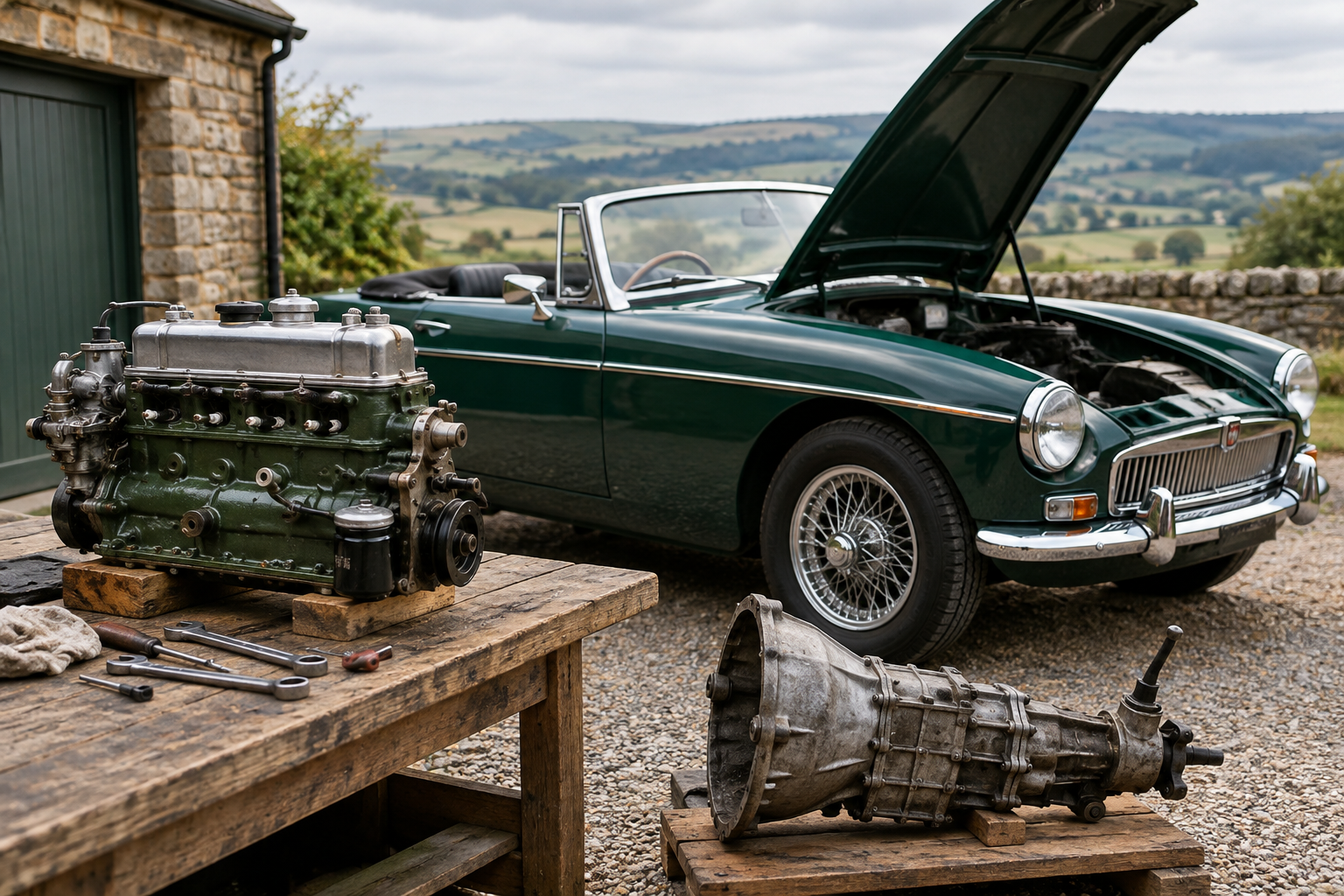
The engine and gearbox define much of an MGB’s character. A sound car should feel straightforward and enjoyable to drive, with a willing engine, a positive gear change and a driveline that behaves predictably. When these systems need attention, the symptoms are often confusing: a noise may come from the gearbox, clutch, propshaft or rear axle, while poor running may be caused by fuel, ignition, cooling or electrical faults rather than the engine itself.
Understanding how the main components work together makes ownership easier. It also helps when deciding whether to preserve an original specification, improve a tired system or commission more extensive work. This guide looks at the principal MGB engine and gearbox arrangements, the checks that matter during ownership and the approach to repairs and upgrades.
The MGB powertrain in simple terms
An MGB uses a front-mounted petrol engine driving the rear wheels. Power passes through the clutch and gearbox, along the propshaft, into the rear axle and then to the rear wheels. Each part has a separate job, but wear in one area can affect how another feels.
The clutch allows the engine to be disconnected from the gearbox when selecting a gear or stopping. The gearbox provides different ratios for pulling away, cruising and climbing gradients. The propshaft transmits power to the rear axle, which changes the direction of drive and distributes it to the rear wheels.
This arrangement is mechanically accessible compared with many modern cars, but age introduces its own complications. Seals harden, cables stretch, bushes deteriorate, fasteners become difficult to remove and previous repairs may not follow the original design. Diagnosis should therefore begin with observation rather than assumptions.
MGB engine variations and what they mean
Most familiar MGBs are associated with the four-cylinder B-Series engine. It is a simple, established design with a character that suits the car well. The engine’s condition matters more than a claimed specification: a carefully maintained standard engine can be more satisfying than a poorly executed modified one.
Some MGBs were fitted with larger or different engines during their development, and many have been changed by owners over the years. Engine swaps can provide useful performance or drivability improvements, but they may also alter cooling requirements, exhaust routing, wiring, engine mounting, braking demands and the overall balance of the car.
When inspecting an engine, look beyond cleanliness. Oil staining may be minor seepage, or it may indicate a seal or gasket that needs attention. Blue exhaust smoke can suggest oil entering the combustion process, while persistent white smoke after the engine has warmed may require investigation. Black smoke and a strong smell of unburnt fuel can point towards mixture or fuel-system problems. None of these signs should be diagnosed in isolation.
Listen for the difference between normal mechanical noise and a new or worsening knock, rattle or tapping sound. A cold engine may sound different from a warm one, and an engine that has stood unused may need careful recommissioning before its condition can be judged properly. Oil pressure, coolant temperature and charging voltage should also be observed through suitable gauges or tests rather than guessed from the engine’s sound alone.
Carburettors, fuel and ignition
Many MGB running faults begin outside the engine itself. Carburettors must be correctly adjusted and supplied with clean fuel at the appropriate pressure. Air leaks, worn spindles, sticking pistons, blocked passages and incorrect float settings can all affect starting, idle quality and throttle response.
Fuel hoses deserve particular attention on any older car. Rubber deteriorates with age, and a hose can look acceptable externally while becoming hard, cracked or insecure at its connections. The fuel tank, pump, filter and metal pipes should be considered as part of the same system.
The ignition system also requires a methodical approach. Plugs, leads, the distributor, timing components and electrical connections all influence how the engine starts and runs. A car that has been modified with electronic ignition may still need careful checks of timing, earth connections and power supply. Replacing parts at random can make diagnosis more difficult, so testing one stage at a time is usually more effective.
Cooling and lubrication
A dependable cooling system is essential for an MGB used in modern traffic. The radiator, hoses, thermostat, water pump, fan arrangement and coolant passages should work as a complete system. Overheating may result from restricted airflow, internal corrosion, a faulty thermostat, a slipping belt or an inaccurate temperature indication.
It is important to distinguish between the gauge reading and the actual condition of the cooling system. A sender, wiring fault or poor connection can produce an incorrect indication. Conversely, an apparently normal gauge does not remove the need to inspect coolant level, leaks and circulation.
Regular oil changes and correct levels are basic but significant maintenance tasks. The specification recommended for a particular engine and its use should be confirmed before servicing. An older engine may also have accumulated deposits or wear that make a gradual, measured maintenance approach preferable to an aggressive flush or an unplanned strip-down.
Understanding the MGB gearbox
The gearbox fitted to an MGB depends on the model and its history. Some cars have four-speed manual gearboxes, with an overdrive unit available on certain specifications. Overdrive is not a separate replacement for the gearbox; it is an additional mechanism that alters the effective ratio when engaged in suitable gears.
A healthy manual gearbox should select gears without excessive force once the car is moving and the oil is at working temperature. A baulking first gear may be influenced by clutch adjustment, while difficulty selecting several gears can suggest a broader problem. A jumping-out-of-gear fault, persistent whining or heavy rumbling warrants proper investigation rather than being accepted as a normal characteristic.
Gearbox noise can be difficult to identify because the sound changes when the clutch pedal is pressed, the car is moving or the throttle is opened. A noise that appears only under acceleration may have a different source from one that occurs during overrun. The propshaft, differential and rear axle should therefore be assessed alongside the gearbox.
Clutch operation and gear selection
The clutch hydraulic system and operating mechanism have a direct effect on gear selection. Air or leakage in the hydraulics, a worn master or slave cylinder, incorrect adjustment or deterioration in the release mechanism can prevent the clutch from disengaging fully.
Typical symptoms include difficulty selecting reverse, crunching during gear changes, the car attempting to move with the pedal fully depressed or a clutch that engages very close to the floor or at the top of its travel. These symptoms do not automatically mean that the friction plate needs replacing. Hydraulic and adjustment checks should come first.
When a clutch does require replacement, the surrounding components should be considered while access is available. The condition of the release bearing, cover, driven plate, pilot arrangement and rear engine seal can influence the durability of the finished repair. The correct solution depends on the condition of the individual car, not simply on fitting the most expensive available parts.
Propshaft, differential and rear axle
After the gearbox, drive passes through the propshaft to the rear axle. Universal joints, sliding splines, mounting points and fasteners need inspection. Play in a joint may produce a clunk when taking up drive, while vibration can be associated with wear, imbalance, misalignment or a mounting problem.
The differential contains gears and bearings that require lubrication. A light seepage around a seal should not be ignored indefinitely, because a low oil level can increase wear. A whine that changes between acceleration and overrun may indicate wear within the differential, although accurate diagnosis requires a road test and inspection by someone familiar with the system.
Rear axle ratios influence the way the car feels. A lower numerical ratio may suit relaxed cruising, while another ratio may provide stronger acceleration at the expense of engine speed. The best choice depends on the engine, gearbox, wheel and tyre combination, intended use and the owner’s priorities.
Originality, refurbishment or modification?
There is no single correct specification for every MGB. Preserving a sound original system can be the right choice for a car with strong history and good mechanical condition. A sympathetic refurbishment may be more appropriate where parts are worn but the basic layout remains suitable. Modifications should be judged by their integration into the car rather than by the parts list alone.
Useful improvements may include better electrical connections, improved cooling control, renewed suspension bushes, more effective braking components or an engine rebuild matched to the way the car is driven. Changes to engine output should be considered alongside clutch capacity, gearbox condition, axle suitability, brakes, tyres and suspension. More power is not automatically a better result if the rest of the car cannot use it confidently.
For examples of how a rebuilt MGB can be specified as a complete project rather than a collection of unrelated upgrades, see the MGB rebuild specification. The appropriate approach will still vary from one car to another.
How to approach mechanical work
Begin with a written list of symptoms and the conditions in which they occur. Note whether a noise is present when cold or hot, under load or on overrun, with the clutch engaged or released, and at a particular road speed or engine speed. This information can save time during diagnosis.
Ask for the cause of a fault to be explained before authorising major work. A compression test, oil-pressure check, fluid inspection or road test may provide more useful evidence than replacing several unrelated components. If the engine or gearbox is removed, photograph connections and record removed parts so that reassembly remains controlled.
When viewing completed work, look for sound workmanship: secure wiring, correctly routed hoses, clean fluid connections, appropriate fasteners and no signs of avoidable leaks. A tidy engine bay is welcome, but mechanical function, accessibility and serviceability matter more than appearance alone.
California Classics (Hull) Ltd works with MGBs and other classic cars, and owners can use the contact page to make an enquiry about their own requirements. If you are researching available cars, the current stock page may also be useful; previous examples can be viewed through sold cars.
The aim: a balanced, usable MGB
An MGB’s engine and gearbox should be considered as part of a wider mechanical system. Good results come from matching condition, specification and intended use. Whether the goal is an original road car, a long-distance GT or a carefully improved Roadster, the priority should be predictable operation and maintainable workmanship.
By listening carefully, checking systematically and resisting unnecessary changes, owners can make informed decisions. That approach preserves the qualities that make an MGB appealing while allowing sensible improvements where the individual car genuinely needs them.