
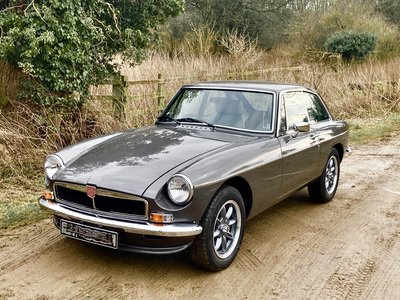
A properly built MGB V8 does not stay available for long. That is the clearest sign of the rising demand for MGB V8s, and it is being felt across the market by buyers who want more than a badge and a noisy exhaust. They want a car with the right stance, the right specification, proven workshop standards and the sort of road manners that make it worth owning for years rather than one summer.
That change matters, because MGB V8s sit in a very specific part of the classic market. They offer the familiar appeal of the MGB, but with the extra torque, flexibility and character that many owners feel the standard car always hinted at. A good one feels complete. It has pace without losing usability, and it remains one of the most appealing ways to own a British sports car that can still be driven properly on modern roads.
What is driving the rising demand for MGB V8s?
Part of it is simple supply and demand. There were never huge numbers of original factory V8s to begin with, and genuinely well-prepared rebuilt examples are not easy to find either. The market has matured. Buyers are less interested in speculative projects and far more interested in finished cars with clear documentation, sensible engineering and a standard of preparation that removes the usual guesswork.
The other part is how well the V8 formula suits current classic ownership. Many enthusiasts are no longer looking for a car that exists only for occasional sunny-day outings. They want something that starts well, runs cleanly, pulls strongly and is comfortable covering distance. The MGB V8 answers that brief better than many classics because it combines straightforward mechanical architecture with genuine touring ability.
Practical ownership advantages also play their part. Historic vehicle tax status and ULEZ exemption make a real difference for many UK owners. That does not turn a classic into a cheap hobby, but it does improve the case for a usable one. When buyers can have V8 performance, classic character and favourable historic vehicle status in the same package, interest tends to strengthen.
Why buyers are moving towards workshop-backed cars
The rise in demand has not lifted every car equally. That is worth understanding. Buyers are paying closer attention to who built the car, how it was built and whether the specification makes mechanical sense. A V8 conversion or rebuild is only as good as the engineering behind it.
That means the market now places a premium on evidence. Buyers want to see what has been done to the shell, cooling system, suspension, braking setup, axle, gearbox and fuelling. They want to know whether the car has simply had a larger engine fitted, or whether it has been developed as a complete package. There is a world of difference between those two things.
A proper MGB V8 should feel resolved on the road. It should not run hot in traffic, wander under power or feel unsettled when pressing on. It should have braking and suspension suited to the performance on offer. It should also have a specification that suits the intended use, because not every owner wants the same thing. Some prefer a more original grand touring character. Others want a sharper, more overtly performance-led build. Neither is wrong, but both require careful choices.
This is why specialist preparation matters more than ever. In a stronger market, weak cars stand out just as quickly as good ones.
The difference between rarity and real quality
There is sometimes an assumption that rarity alone guarantees value. In practice, rarity gets attention, but quality closes the deal. The rising demand for MGB V8s has made that distinction sharper.
Original factory V8s will always hold a special place, and rightly so. They carry their own importance within the MGB story. But rebuilt or upgraded V8 cars can also be highly desirable when they are done properly and honestly presented for what they are. For many owners, the attraction is not simply originality. It is the driving experience and the confidence that the car has been prepared to a standard that suits modern use.
This is where buyers need to stay disciplined. A fresh coat of paint, smart trim and attractive wheels can hide a very average car underneath. The shell condition still matters. Panel fit still matters. The quality of the restoration still matters. The standard of the conversion or rebuild matters most of all. If the fundamentals are poor, no amount of cosmetic presentation will make the car satisfying to own.
What serious buyers are looking for now
The modern MGB V8 buyer is usually better informed than before. That has changed seller expectations across the board. People are asking sensible questions about engine build details, gearbox choice, rear axle specification, ignition, carburation or injection where relevant, cooling arrangement, ride height and braking components. They also want photographic records, invoices and a clear explanation of the build philosophy.
That does not mean every buyer wants a car laden with modifications. Quite often, the strongest cars are those with a coherent specification rather than an endless list of parts. Balance matters more than novelty. A road car needs tractability, reliability and proper setup. Too many upgrades applied without a clear plan can make a car worse, not better.
Interior finish is being judged more closely as well. If the mechanical side is sorted, buyers then look at whether the cabin supports the overall standard of the vehicle. Poor trim work, tired switchgear and unfinished details can undermine confidence. At this level, presentation is not about polish alone. It is about whether the whole car feels complete.
Prices are rising, but not blindly
Yes, stronger demand has supported values. That is obvious enough. But it would be a mistake to think every MGB V8 is simply climbing in price regardless of condition or provenance. Buyers may be enthusiastic, but they are not careless.
The best cars tend to attract attention quickly because they save time, uncertainty and future expense. That is where much of the value sits. A cheaper car can prove expensive once bodywork, mechanical sorting and specification correction begin. In many cases, the apparent bargain disappears very quickly.
Equally, there is a ceiling on over-optimistic pricing when the car does not justify it. If the build quality is vague, the documentation thin or the engineering questionable, demand cools off. The market may be strong, but it is becoming more selective, not less.
That is healthy. It rewards proper workmanship and gives buyers a clearer sense of where their money is going. It also means sellers who understand the cars and can stand behind them are in a stronger position than those relying on general classic car language and very little detail.
Why the MGB V8 still makes sense as a usable classic
One reason the demand remains durable is that the appeal is not theoretical. An MGB V8 is enjoyable in exactly the way many owners want a classic to be. It has torque where you use it, compact dimensions, familiar parts support and a driving character that suits British roads very well. It can feel relaxed one moment and genuinely urgent the next.
That matters because plenty of classics are admired more than they are used. The MGB V8 tends to avoid that trap when it has been prepared properly. It is a car people actually want to drive. For many buyers, that is the whole point.
It also helps that the MGB itself remains well understood by specialists. Knowledge is not thin on the ground. For an owner thinking long term, that makes a difference. Buying into a specialist-supported model with strong workshop familiarity is often a safer decision than chasing something obscure and hoping for the best.
For those looking across England for the right car, that specialist knowledge is often the deciding factor. A dealer-workshop that knows MGBs in depth can usually spot the difference between a car that merely looks the part and one that has been properly built for real road use.
What the rising demand for MGB V8s means next
The market is unlikely to reward vague cars for much longer. Expectations are too high now. Buyers want correctness where it matters, improvement where it helps and evidence throughout. That should be seen as a positive. It pushes standards upwards and protects the long-term reputation of the best MGB V8s.
For owners, it means well-maintained, well-documented cars should continue to attract serious interest. For buyers, it means patience is still valuable. The right car is worth waiting for, especially when the difference between an average V8 and a sorted one is so obvious from behind the wheel.
At California Classics, that is exactly where the value lies - not in chasing labels, but in understanding how an MGB V8 should be built, presented and driven. If demand keeps rising, the strongest cars will remain the ones that earn it honestly.
The smart move is not to buy the first V8 you see. It is to buy the one that still feels right after the excitement has worn off.